
Adelaide vs. xpln.ai: Attention Measurement Compared

Attention metrics increasingly shape how media is measured, planned, and bought. As attention influences more buying decisions, understanding what each metric actually measures becomes more important. Two metrics can draw on similar underlying research yet produce very different signals depending on what each model is built to measure.
xpln.ai's solution focuses on predicted attention duration. Its eye-tracking-trained models generate an impression-level estimate of attentive time, which xpln.ai positions as a real-time media signal. Adelaide takes a different approach with AU, combining eye-tracking and other attention research with placement and device signals and full-funnel outcome data to assess media quality at the placement level.
The clearest difference is what each company’s model ultimately produces. xpln.ai estimates attentive time; AU scores media quality based on a placement’s likelihood of capturing attention and contributing to business outcomes, with outcome data directly informing model training and validation.
How xpln.ai Predicts Attention Duration
xpln.ai uses eye-tracking data and machine learning to estimate attention duration at the impression level. Its current CESP disclosure identifies Attention Time, defined as estimated fixation time, as its primary metric. Related measures include Attention Rate, Cost per Attentive Second, and attentive CPM.
Those predictions draw on a limited amount of eye-tracking research combining in-lab and webcam measurement across the open web, YouTube, social platforms, CTV, and other media environments. xpln.ai’s models pair that research with impression-level signals, such as viewability, ad position, clutter, page context, traffic source, and interactions. The models then estimate attention time for impressions that weren’t directly eye-tracked, turning predicted attention into a signal for programmatic inventory selection and activation.
xpln.ai has published case studies linking predicted attention to recall, consideration, engagement, and conversion. These analyses show how attention relates to performance, but the core metric remains predicted attentive time.
xpln.ai also offers Ideal Attention Time (IAT). This separate, creative-focused product analyzes an asset frame by frame to estimate the minimum attention needed for an objective, giving marketers a creative-specific threshold for planning. That threshold is circular, though. IAT derives a creative's “ideal” attention time from the creative itself, so the number can only describe how long that specific asset needed, not whether it's working.
xpln.ai’s time-based measures fall within what Adelaide calls duration-based attention metrics, or DBAMs. Duration can help explain audience engagement and creative quality, since the creative itself plays a major role in how long attention is sustained. But that sensitivity to creative and other factors limits duration as a measure of media quality or an optimization target.
How Adelaide AU Measures Media Quality
AU uses attention data differently. Instead of making attentive time the final metric, Adelaide uses eye-tracking research to identify the characteristics of media placements that influence attention. Adelaide draws on fully opted-in eye-tracking data licensed from providers including Lumen Research, Tobii, TVision, and Amplified Intelligence, as well as in-house research.
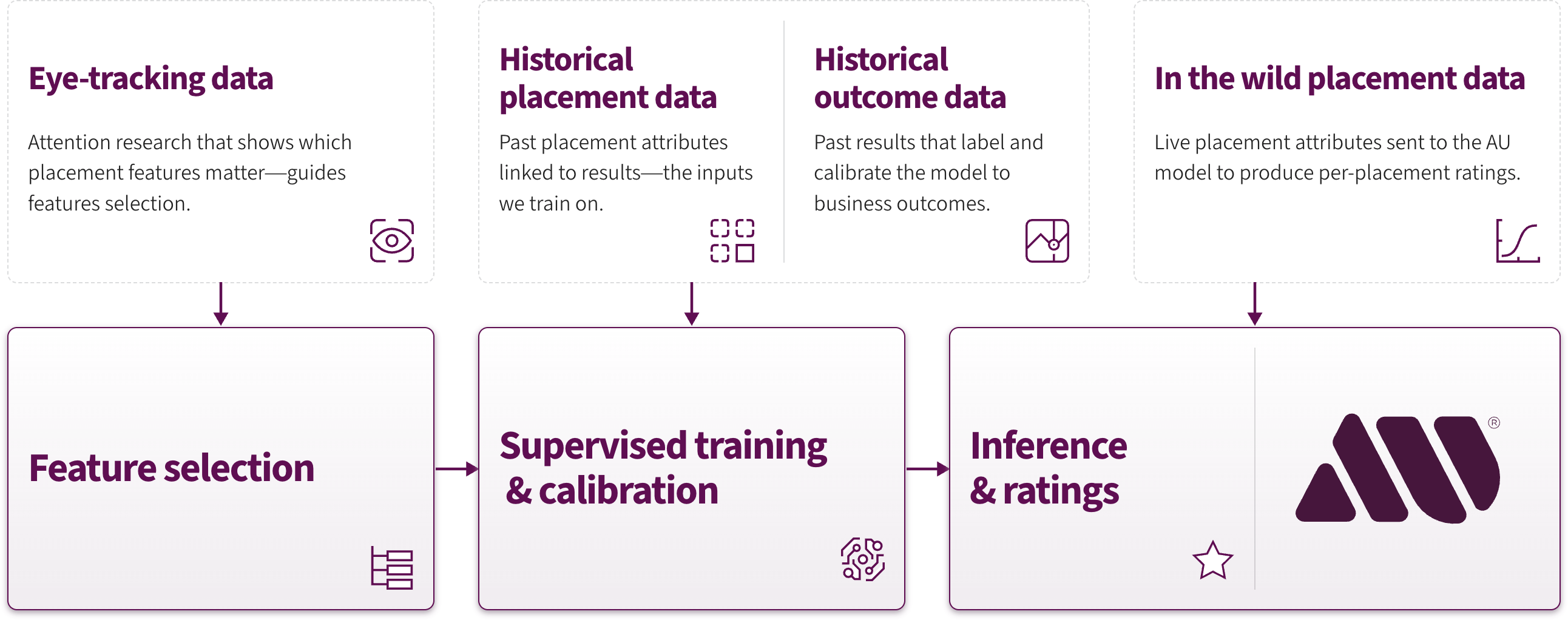
The relevant characteristics vary by media environment. On the web, eye-tracking research helps identify signals such as ad coverage, page clutter, placement position, duration, and page velocity; in CTV, relevant factors include app, genre, pod position, and time of day. These signals feed Adelaide’s channel-specific models; real-world outcome data spanning brand lift, conversions, and sales determines how they are weighted based on their relationship with performance.
The result is AU, a normalized 0–100 media quality score that predicts a placement’s likelihood of capturing attention and supporting business outcomes. The same framework applies across all 19 channels Adelaide measures, including display, OLV, CTV, linear TV, social, audio, DOOH, and cinema.
AU is designed to isolate media quality from the performance of a specific creative or audience. Creative quality is measured separately but can be connected back to AU scores. Through Adelaide’s AU Ecosystem for Creative Partners (AECP), third-party creative assessments can inform a Creative AU Adjustment that recommends the media quality level suited to a particular asset and desired result.
Why Predicted Attentive Time Is Not the Same As Media Quality
xpln.ai can predict how much attentive time an impression is likely to receive, but more predicted attention doesn’t necessarily mean a higher-quality placement. Time-based measures are shaped by the media environment, the creative, the audience, and the format in which an ad appears.
Creative makes the issue especially clear. A surprising or visually complex ad may hold attention longer without necessarily delivering stronger business impact. xpln.ai’s own IAT reinforces the point that the “right” amount of attention varies by creative and objective, which is why duration alone cannot tell advertisers whether one placement is higher quality than another.
Audience characteristics can shift attentive time, too. Older demographics and brand-aware consumers tend to spend more time with ads, meaning higher duration can partly reflect who is seeing the ad rather than the quality of the media.
Those limitations become more consequential when predicted attentive time is used as a buying signal. Optimizing toward more seconds can favor impressions for reasons unrelated to media quality, while the target itself lacks consistent meaning across formats. Five seconds of attention on display, OLV, and CTV represent very different advertising experiences, and additional seconds do not necessarily create value at a constant rate.
That same variability makes predicted attentive time a difficult basis for publisher guarantees. Duration reflects the audience and creative as well as the placement, putting much of the metric outside a publisher’s control. A seller can stand behind the quality of a placement it built, but not how long a brand’s creative will hold someone’s attention. That gives publishers little reason to guarantee attentive time as a transacting currency. AU instead scores the placement itself.
Independent Validation of Adelaide AU and xpln.ai Attention Time
MediaSense audited AU in 2025, evaluating Adelaide's scoring methodology and AU Curve Materiality Analysis. MediaSense reconstructed AU curves across Aided Awareness, Familiarity, Intent, and Recall and tested the relationship between AU and each KPI.
The review found statistically significant positive relationships across all four KPIs, with higher AU associated with stronger performance. MediaSense also found the methodology transparent, reproducible, and independently verifiable.

CESP’s Attention Grid does not currently report a completed third-party audit for xpln.ai. According to the MRC, xpln.ai completed its pre-audit review in Q3 2025, and its audit is in progress for specified display and video impressions, viewability, and attention metrics across mobile web and in-app environments. Adelaide completed its MRC pre-audit review in Q2 2026 and continues through the accreditation process for AU across digital display and video on desktop, mobile, and in-app.
Coverage & Programmatic Activation
Both xpln.ai and Adelaide support programmatic activation, but they optimize toward different signals. xpln.ai uses predicted attentive time for pre-bid targeting, custom bidding, and SSP-based activation, turning its impression-level prediction into a real-time buying signal.
Adelaide activates AU through pre-bid targeting and suppression, high-AU PMPs, and custom bidding across 125+ integrations spanning major DSPs, SSPs, publishers, and other media platforms, with off-the-shelf activation widely available. The same AU score can be used consistently across planning, buying, and media partner evaluation.
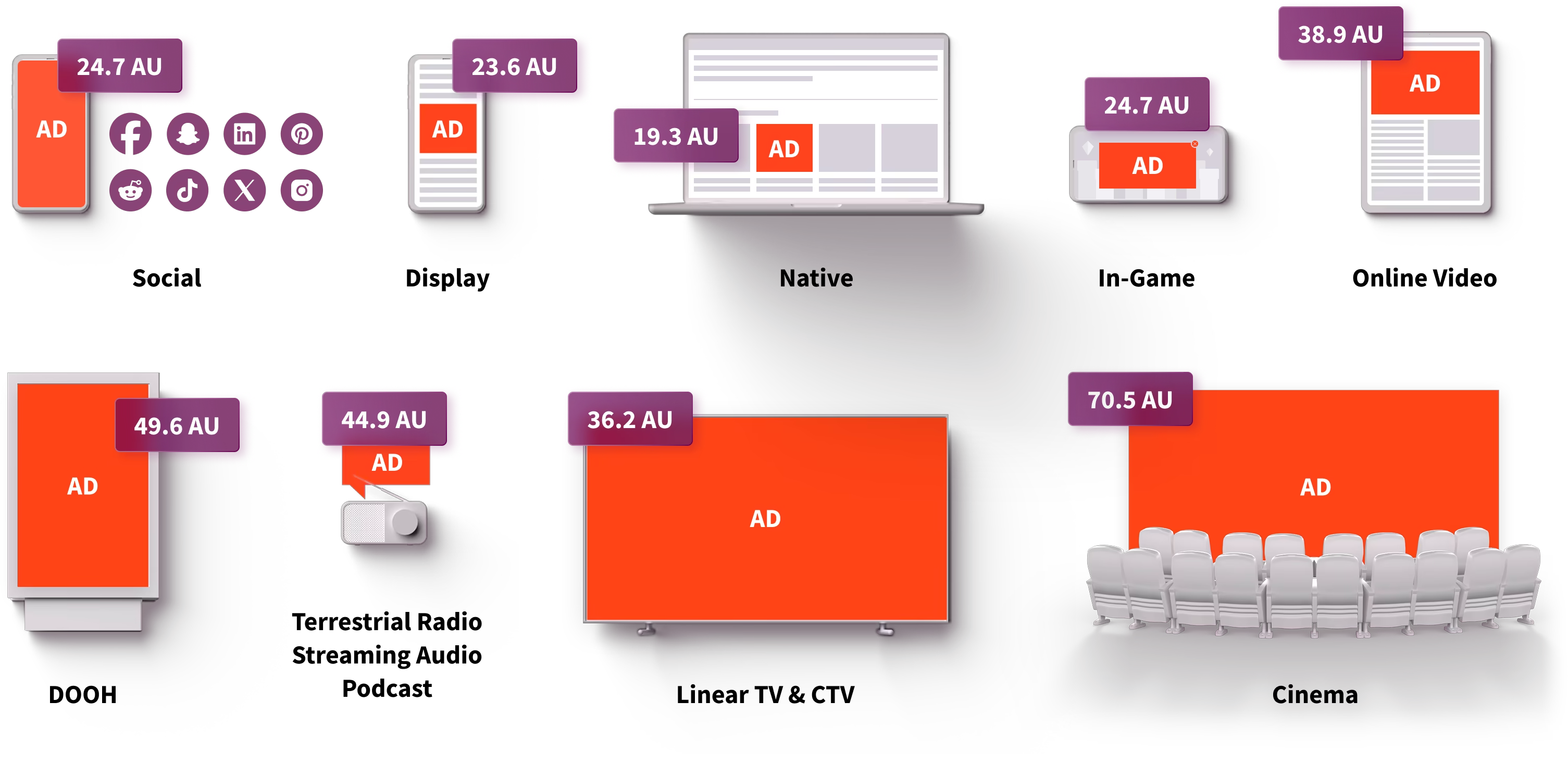
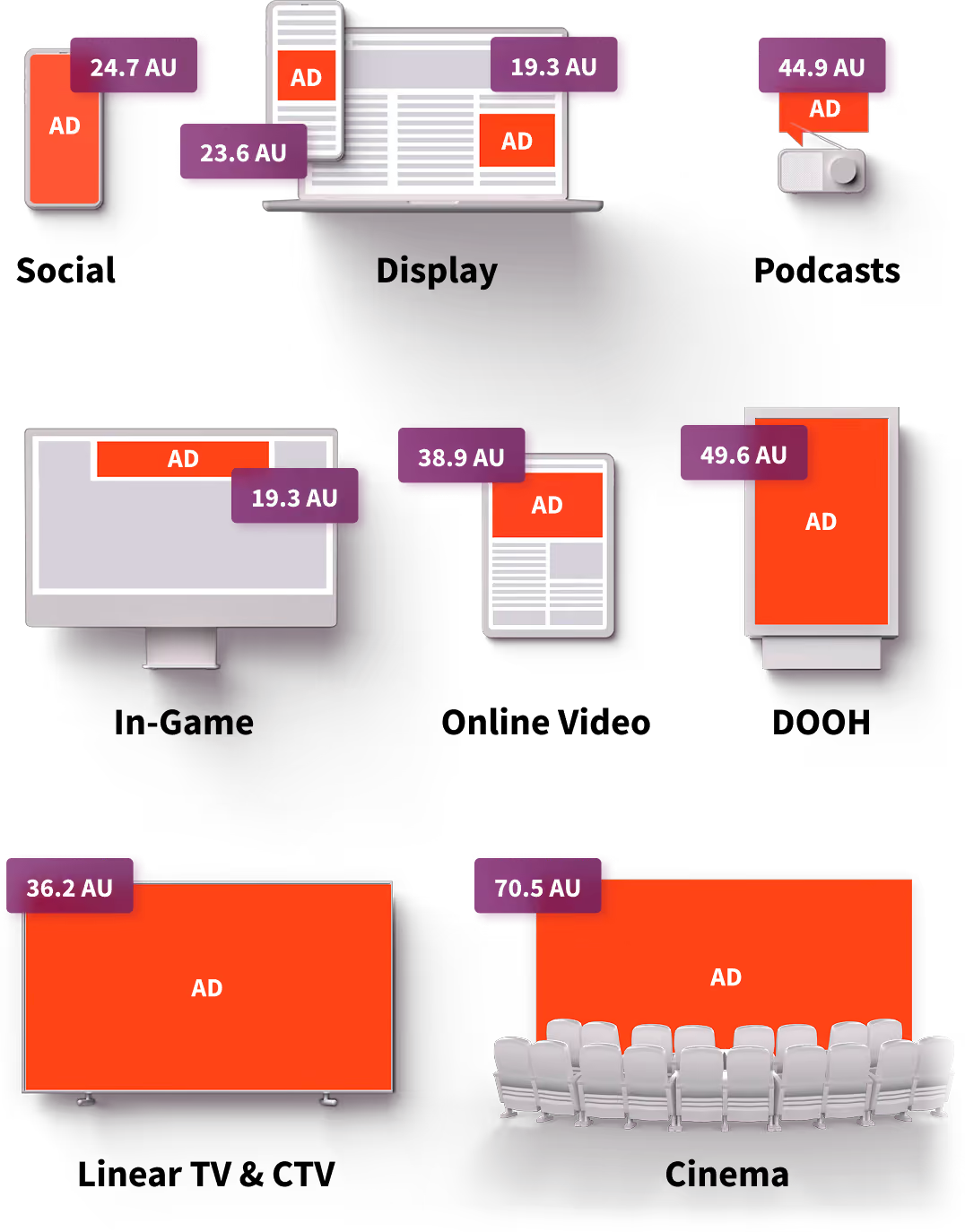
The methodological difference carries through to activation: xpln.ai prioritizes inventory based on predicted attentive time, while Adelaide uses a media quality score trained and validated against business outcomes.
Duration-based metrics like xpln.ai’s are also a difficult fit for marketing mix modeling. MMMs need consistent inputs across channels, and a second of attention isn’t equivalent across formats. Because its meaning changes by environment, duration cannot be normalized across a media mix in the same way. AU, by contrast, isn’t expressed in time. Its outcome-trained, placement-level score is normalized across channels, giving MMMs a more consistent input for models trying to isolate media’s contribution to results.
xpln.ai vs. Adelaide Comparison
When To Work With Adelaide vs. xpln.ai
Choose xpln.ai when the primary goal is to measure predicted attentive time or use duration as a programmatic buying signal. Its impression-level Attention Time metrics support activation, while Ideal Attention Time provides a creative-specific threshold for planning.
Choose Adelaide AU when you want to evaluate, compare, and optimize media quality across your media plan. AU combines attention research with placement signals and outcome data to produce a placement-level 0–100 score that works across 19 channels.
Adelaide views duration as particularly useful to understand engagement and creative quality, but does not recommend optimizing media toward attentive time itself because factors beyond media quality influence duration. For advertisers using media quality to guide planning and buying across channels, AU provides a consistent, outcome-trained signal.